Saturday, 13 October 2012
Survival Readiness: Cutting Edge of Outdoor Life
Survival Readiness: Cutting Edge of Outdoor Life: Every good boy scout knows about having a decent penknife in his pocket. Today, multi-tools available to outdoor types have come a long wa...


Friday, 18 March 2011
Friday, 28 January 2011
How to Clean and Reproof: Walking Boots
Walking boots are possibly the most essential and personal piece of outdoor kit you can buy, but once you've found that perfect pair you'll want to keep them in tip-top shape.

So often walking boots get slung in a cupboard caked in mud and forgotten about until the next trek. This does reduce their lifespan, and can cause uppers to rot or crack, soles to fall off and general unpleasant odours to form. (Faults caused by neglect are usually not covered by a manufacturer's warranty, which will stipulate that you need to show some respect for the product.)
Thankfully cleaning and re-waterproofing your walking boots is both quick and easy with the right know-how!
Thursday, 27 January 2011
Maldon Mud Race
It’s one of the most quirky events in the sporting calendar - and certainly one of the dirtiest!
The Maldon Mud Race on the Blackwater Estuary in Essex takes place every winter, and attracts some 250 entrants and thousands of spectators each year.
The race involves a 400-metre dash across the riverbed of the River Blackwater on the edge of the Essex Marshes. Participants, many in fancy dress, battle their way through thick, black, oozing mud and shallow waters from one side of the river to the other, often completing the course on hands and knees.

Legend has it that the race, which started nearly 40 years ago, is rooted in far more ancient history. The famous Battle of Maldon in 991, between the Danes and Anglo Saxons, resulted in the loss of the legendary Saxon leader, Britnorth. He was beheaded somewhere along the Blackwater, and although his body was recovered, his head never was. Wading through the thick sludge at low tide, the mud-caked participants of today are said to be searching in vain for the missing head of their long-lost leader.
The ‘Mad’ Maldon Mud Race takes place only when tidal conditions allow, attracting attention from all over the world, including TV cameras from as far away as Australia and the USA.
Last time round it raised over £22,000 for charity.
Unfortunately there's no more spaces left for entrants this year, but if you're free on the 25th April and fancy a laugh for a good cause (followed by an excellent pub lunch) then why not pop down and watch!
Visit www.maldonmudrace.com for more information.
Friday, 21 January 2011
How to Clean and Reproof: Waterproof Clothing
Over time, dirt from the environment and oils from sweat will 'clog' waterproof fabrics, and the Durable Water Repellent on the outer face of the garment will degrade. 
These issues lead to a huge drop in breathability in all waterproofs - from PU coatings like The North Face's HyVent to membranes like Gore-Tex - which can make it feel like the jacket is leaking, when really it's not.
Luckily enough cleaning and reproofing a waterproof garment is very simple and will keep your jacket or trousers performing like new for many years.
Read our new guide on how to achieve the best from your waterproof!

These issues lead to a huge drop in breathability in all waterproofs - from PU coatings like The North Face's HyVent to membranes like Gore-Tex - which can make it feel like the jacket is leaking, when really it's not.
Luckily enough cleaning and reproofing a waterproof garment is very simple and will keep your jacket or trousers performing like new for many years.
Read our new guide on how to achieve the best from your waterproof!
Wednesday, 19 January 2011
Beginner's Guide to Base Layers
Base Layers (sometimes referred to as thermals) are the foundation of the layering system, and we believe, the most important layer to get right. You can have the world's most expensive Gore-Tex jacket, but wear a cotton t-shirt underneath and you may as well be wearing a bin-bag for all the benefit you'll feel.

There is a bewildering variety of base layers available on the market today, suitable for all activities and weather conditions from Arctic exploration, to running in the Desert (which is why we don't call them the generic 'thermals'). In this guide we'll look over the main types of base layer, and some of the things you may wish to think about when purchasing.
Friday, 14 January 2011
Tunisia Travel Advice
As you may be aware, Tunisia is experiencing some domestic trouble.
The Foreign Office has advised not travelling there unless absolutely essential.
For more the latest info visit the FCO site
Wednesday, 12 January 2011
A helmet that comes apart! Wild Country Alpine Shield
 The new cool new Alpine Shield helmet is uniquie. It is both a regular style climbing helmet and also an ice climbing lid.
 The Alpine Shield helmet is the worlds first truly modular climbing helmet and the first to allow a choice of protection levels at the turn of a screw! A high performance EPS inner is complemented by an optional outer shell that attaches quickly and easily to make a stronger, safer unit for harsher conditions.
Below is a review posted on UKClimbing.comReviewed very positively by Hamish Dunn he says of the Alpine Shield that:
'This helmet will suit the climber who wants to buy one helmet which will perform in all types of climbing. A balance of looks and usability coupled with a reasonable price tag make this a strong contender in the ever growing helmet market. When you consider the cost of buying a hard shell and a foam shell helmet it's really a no-brainer.
Monday, 10 January 2011
Travel article from Icy Astana in Kazakstan
Paul Taylor is currently out in Kazakhstan and has been sending back some pictures and a bit of a diary about his travels. If you thought we were having a cold winter check out the pictures below.

 The first couple of pictures show the view from a bridge over the river that runs through the city. There are three buildings that look the same to the top left of the picture (as you look at it). We are staying in the block furthest to the left (last one in the picture). As you can see we are close to the river.

All along the river they have built ice sculptures and ice slides for the kids. In the picture above you can see one on the bank of the river (directly below the house block to the right of our house). Its amazing what you can do with some 'ice bricks' and some frozen water. There are a lot of ice sculptures along the river as well. I took a photo of one of the bigger ones of a rabbit. Astana is hosting the winter Asian games in a couple of weeks time - so they have done lots of nice things to make the city attractive (the lights in the evening are very impressive!).

And then there are lots of ice slides for the kids. These have been made out bricks of ice. I have had to dig out my Rab Summit Jacket as its the only thing which will keep me warm out here!


You can see the ice skating rink that has been made on the river (unbelievably, its a beach in the summer). There's even a track that heads off from the rink and makes a circle down the river.
All along the river they have built ice sculptures and ice slides for the kids. In the picture above you can see one on the bank of the river (directly below the house block to the right of our house). Its amazing what you can do with some 'ice bricks' and some frozen water. There are a lot of ice sculptures along the river as well. I took a photo of one of the bigger ones of a rabbit. Astana is hosting the winter Asian games in a couple of weeks time - so they have done lots of nice things to make the city attractive (the lights in the evening are very impressive!).
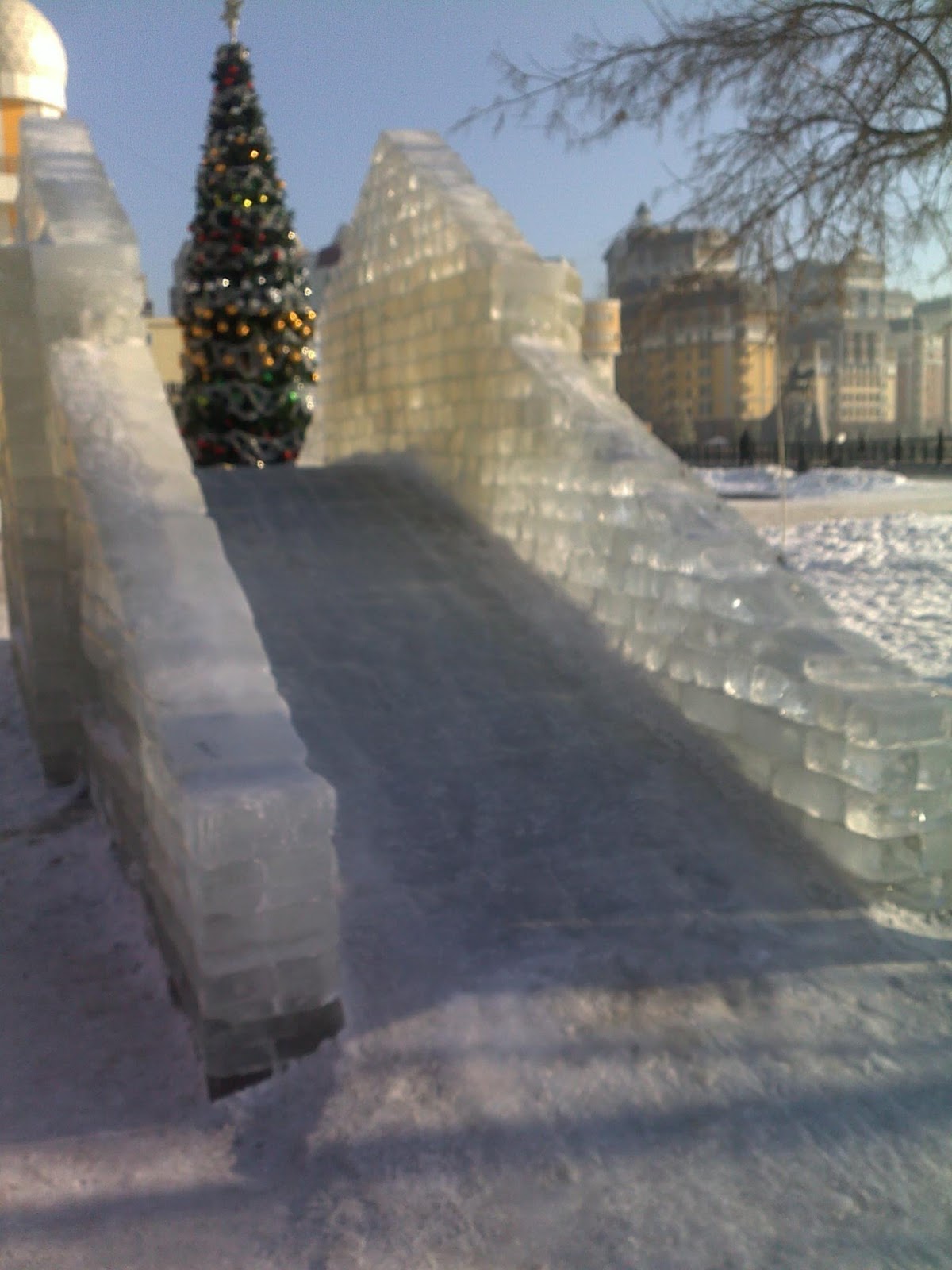
And then there are lots of ice slides for the kids. These have been made out bricks of ice. I have had to dig out my Rab Summit Jacket as its the only thing which will keep me warm out here!
Ghyll Scrambling
From vertex to vortex…ghyll scrambling is the extreme sport of hurtling down a mountain waterfall, one of the fastest-growing sporting activities in Britain
Head for the hills and traverse along a rocky mountain path as you make your way steadily upwards – and then take the plunge and slide down a waterfall or natural rock chute into the swirling waters below. It’s been likened to white water rafting…without the raft!
Ghyll-scrambling – also known as gully bashing and canyoning – has become a huge hit with adrenalin junkies from the Brecon Beacons to the Lake District . These hardy adventurers think nothing of throwing themselves off a rocky outcrop into the middle of a thundering waterfall, battling with the racing waters on their downward descent.
Even during the summer months the water temperature can be somewhat invigorating to say the least. And in winter, with howling winds perhaps whipping the icy water into a frenzy, how to stay warm and dry in the raging torrent is a challenge in itself.
Being professionally equipped with the right clothing is essential for both safety and comfort.
Thermal base layers are a given, worn under a full steamer wetsuit and waterproof salopettes and jacket.
Neoprene socks and gloves will go a long way towards directing heat to the extremities, and although sturdy Wellington
Safety helmets, such as those used in rock-climbing, should always be worn.
Look online for a centre where you can try this activity with qualified instructors
Friday, 7 January 2011
How to clean down jackets

I often say to customers that washing down gear isn't hard it's the drying which needs extra care.
Take a look at the guide to see how to wash by had or machine, dry and re-proof your coat
Click here
Monday, 27 December 2010
Check out our brand new Facebook page
We are fully socially networked now. Due to popular demand we now have a Gear Zone Facebook page. Please follow us at http://www.facebook.com/pages/Gear-Zone/181869375175181
Don't forget our Twitter feed too at www.twitter.com/Gear_zone
Keep in touch via one of these forms to find out about the latest products, news and promotions
Don't forget our Twitter feed too at www.twitter.com/Gear_zone
Keep in touch via one of these forms to find out about the latest products, news and promotions
Monday, 13 December 2010
Why are footballers wearing Snoods? or as we outdoors types call them - Buff's
Rant time!
Why are footballers wearing snoods or neck warmers? I understand the possible need for gloves and definately thermal base layers but seriously are they that cold they need to wear a scarf.
Well, IF your son or daughter is bothering you to buy them a neckscarf so they look like Samir Nasri then I suggest you consider a Buff. These are neck tubes made of a seamless stretchy and breathable material. There is also a fleece version available for those who really feel the cold.
Joking aside, I have used one for years now skiing and on the bike. They can be pulled up over the mouth and nose to keep the chill off of your face whilst still breathable.
They are reasonably inexpensive and come in a huge and varied range of designs and can be twisted and turned in to a hat, balaclava or bandana.
What the demo now you've heard about there amazing uses.
Why are footballers wearing snoods or neck warmers? I understand the possible need for gloves and definately thermal base layers but seriously are they that cold they need to wear a scarf.
Well, IF your son or daughter is bothering you to buy them a neckscarf so they look like Samir Nasri then I suggest you consider a Buff. These are neck tubes made of a seamless stretchy and breathable material. There is also a fleece version available for those who really feel the cold.
Joking aside, I have used one for years now skiing and on the bike. They can be pulled up over the mouth and nose to keep the chill off of your face whilst still breathable.
They are reasonably inexpensive and come in a huge and varied range of designs and can be twisted and turned in to a hat, balaclava or bandana.
What the demo now you've heard about there amazing uses.
Monday, 6 December 2010
Icebreaker Mondo Zip Wins Country Walking’s Best In Test
I received the below article from our friends at Icebreaker today and thought you might be interested in what they say.

Icebreaker’s Mondo Zip has won Best In Test in the “Men’s base-layers” gear test feature in the January 2011 issue of Country Walking. Gear tester Andy Cremin said of the Mondo Zip “it works well over a wide range of temperatures...gives plenty of warmth when you need it,” and continues to praise the base-layer’s breathability, commenting: “It wicks sweat incredibly well,” and Icebreaker’s unique anti-bacterial, odour resistant qualities: “Body odour isn’t really an issue either, with several days of use being perfectly possible without any obvious stink rearing its ugly head.” The tester also liked the versatility of the zip neck, and that the sleeves can be easily rolled up in warmer conditions.
His verdict: “Icebreaker’s classic merino...nudged into the lead with its quality fabric, decent cut and...more comfortable feeling against the skin.” The concluding observation of the review echoes Icebreaker’s philosophy: “Overall...natural materials perform better than man-made fabrics.”
Publication: Country Walking
Icebreaker’s Mondo Zip has won Best In Test in the “Men’s base-layers” gear test feature in the January 2011 issue of Country Walking. Gear tester Andy Cremin said of the Mondo Zip “it works well over a wide range of temperatures...gives plenty of warmth when you need it,” and continues to praise the base-layer’s breathability, commenting: “It wicks sweat incredibly well,” and Icebreaker’s unique anti-bacterial, odour resistant qualities: “Body odour isn’t really an issue either, with several days of use being perfectly possible without any obvious stink rearing its ugly head.” The tester also liked the versatility of the zip neck, and that the sleeves can be easily rolled up in warmer conditions.
His verdict: “Icebreaker’s classic merino...nudged into the lead with its quality fabric, decent cut and...more comfortable feeling against the skin.” The concluding observation of the review echoes Icebreaker’s philosophy: “Overall...natural materials perform better than man-made fabrics.”
Publication: Country Walking
Issue: January 2011
Thursday, 25 November 2010
Earbags - You need to see them to believe them
Once a sales rep, who I have known for a long time showed me a new Swedish product called an Earbag. This small fleece accessory fits over your ears and is basically an ear warmer. I thought these items were a bit daft but Chris persuaded me to take some.
Well they are now one of our best selling items. We sell them in three sizes and a variety of colours. This year we have sold them to walkers, skiers and mainly people who want to stop their ears getting cold.
Check out this wonderfully unique Youtube video!
Well they are now one of our best selling items. We sell them in three sizes and a variety of colours. This year we have sold them to walkers, skiers and mainly people who want to stop their ears getting cold.
Check out this wonderfully unique Youtube video!
Friday, 19 November 2010
The North Face
Great news! We are proud to announce the launch of The North Face clothing and equipment.
We have just launched the new season’s range of The North Face to our expanding product line.
We have a comprehensive collection including key pieces from the Summit Series, Rucksacks, Down insulation and footwear.

Keep your eyes on the site for more new exciting gear from one of the worlds leading outdoor brands.
A Guide to Choosing a Sleeping Bag
Here is a guide to buying sleeping bags.
The main questions to ask; first, what is the lowest temperature that you are likely to experience? Secondly, will you be carrying the bag and in what type of environment will it be used?


Comfort Temperature Ratings
EN 13537 provides a standard and uniform method of measuring the performance of a sleeping bag within the European Union, and allows consumers to compare different sleeping bags from different brands accurately. The testing within EN 13537 also provides a comfort temperature range shown as the T (comfort) and T (limit), to suggest a range of use depending on the individual user.
The T (comfort) is related to a woman and the T (limit) is related to a man. The T (extreme) is to be considered only in very extreme situations. The ratings from the EN13537 test compare the performance of sleeping bags under very controlled standard test conditions, they do not take into account the many various conditions encountered in use such as wind, posture, clothing, ground insulation, humidity or the individual's physical or psychological state (hunger, fatigue etc.). Therefore these temperature ratings should be used as a guideline and adapted to each individual's situation. To avoid confusion and to assist in helping make the right decision Deuter sleeping bags also carry a Comfort Zone recommendation based on experience but as with EN13537, individual circumstances should be considered and advise from the retailer taken.
TIP: As a general rule, if you think you feel the cold more than the average person then go for a bag which has a comfort rating 5ºC colder than the conditions will be. For example, if you expect –10ºC then buy a –15ºC bag.


Insulation Materials: Down versus Synthetic
Natural down clusters and synthetic wadding are the two main types of air-trapping insulation material used to make sleeping bags.
Down Pros
- Warmth to weight ratio is far greater than any synthetic.
- Small pack size.
- Greater breathability.
- Will cover wider range of temperatures.
- Will last years longer if looked after.
Down Cons
- More expensive.
- Useless when wet.
- Difficult to wash and dry.
- Shouldn't be stored compressed.
Synthetic Pros
- Relatively inexpensive.
- Dries and cleans easily.
- Retains up to 70% performance when wet.
- Can be stored compressed (not for long periods.)
Synthetic Cons
- Heavier weight.
- Covers less range of temperature.
- Shorter life span than down.
- Larger pack size
Down is the most efficient and long lasting, the sleeping bags are smaller and lighter and feel much softer, however they do lose their insulating qualities when wet, are difficult to clean and more expensive. Down sleeping bags do offer the best warmth to weight ratio, if you need a very warm bag (-15ºC or lower?) then buy down. Fill power and construction also needs to be considered when buying a down bag. Fill weight tells you how much down is in the bag, however the better the down in terms of fill power the less you need to keep warm. Fill power gives a gauge of how efficient the down is at trapping air – e.g. a 30g sample of down with a fill power of 600+ will occupy a minimum of 600 cubic inches. Therefore, the higher the fill power, the better the performance of the bag.
Note: Fill power is calculated in two different ways depending on origin, either by the American or European method. This results in slightly different figures (500 European = approx 550 American). When you see a bags down/feather ratio it means the following: - 90/10 would mean 90% down and 10% feather. You may ask 'why isn't it 100% down', the answer is that the down requires a certain amount of feather so it has something to cling to – like leaves on a branch. Any less than 3% feathers and the down will have no purchase and will just clump together and not loft. Any more than 10-12% feather and there will not be enough down and the performance will be adversely affected. Construction methods affect the down distribution and therefore insulation, methods such as trapezoidal chamber construction offer good down distribution and resistance to shift, but are more expensive. Stitch through and box wall construction is cheaper but can allow cold spots.
Synthetic Sleeping Bags
Synthetic sleeping bags are less expensive. Synthetic insulation performs better than down when wet but they are bulkier and heavier. Buy synthetic if the bag will be used regularly in damp conditions, be washed fairly frequently or the conditions just don't demand the higher performance of down. The same rules for construction apply to synthetic bags, if stitched through cold spots can form, look for bags with a shingle construction.
Other features to consider:
Hood: test the hood, pull it tight and see whether it feels comfortable and snug.
Shoulder baffle: A shoulder or neck baffle helps to trap warm air inside the bag; these are usually not necessary on summer bags and are more common on bags where a higher performance is required.
Side Zips: Two way zips running the whole length enable you to let your feet cool down and allows you to vent your feet outside the bag in hot weather, check the zip has a guard to ensure it does not snag.
Materials: Nylon or Polyester micro fibre is the standard fabric for both lining and shell as it is breathable, quick drying and durable. Poly cotton or cotton is often used for lining in budget bags but is slow drying and adds weight and bulk.
Proper Storage - When storing your bag it's best to put it in a storage bag or a pillow case as loosely as possible to help the bag maintain its loft. Never use a plastic bag for storage as this will prevent the elimination of any moisture and promote the growth of mildew.
Washing - When it finally comes to the point that you need to wash your sleeping bag, follow these steps:
1. Follow the manufacturer's care label instructions. They know how their product should be cleaned and dried. If any of the points below contradict the label, follow the label instructions.
2. Zip up all zippers (open teeth can snag the shell or lining) and fasteners, then turn the bag inside out so that body oils accumulated on the inside will wash out easily.
3. Always use a front-loading washer, the agitator in a top-loading washer will tear baffles apart or rip the bag itself.
4. For a down-filled bag, use cold water with a gentle detergent like Nikwax Down Wash. For a synthetic fill bag, use cold or warm water with a mild detergent. Whether down or synthetic, wash on the gentle cycle, use as little detergent as possible and no bleach or fabric softener.
5. Run at least one full cycle with no detergent to completely rinse the bag; two if you still detect soap.
6. To remove the bag from the washing machine, gently lift and support the bag from below to prevent water-soaked insulation weight from tearing baffles or ripping stitches.
7. If possible, place in large commercial dryer (home dryers are generally too small to allow sufficient fluffing) on a low heat. Intermittently stop the dryer and be sure that the fill is not clumping to be sure of even drying. Using a tennis ball in the dryer will help fluff the fill.
8. Finally, never dry clean your sleeping bag. The petroleum-based dry cleaning chemicals will damage the bag. With proper care, a quality sleeping bag can last up to 20 years and provide you with many nights of clean, warm, comfortable sleep
Monday, 15 November 2010
A brief guide to Goretex Fabrics
Goretex is one of the most technical fabrics which is used in waterproof jackets and trousers. Below are some frequently asked questions to help you through the choice of buying a jacket.
What is the difference between 2 and 3 layer Gore-Tex garment constructions?
A 3 layer garment is made from 3 layer Gore-Tex. The Gore-Tex membrane is sandwiched between the face fabric on the outside and a knit scrim fabric on the inside - all laminated together to appear as one layer.
A 2 layer garment is made from 2 layer Gore-Tex. The Gore-Tex has only the face fabric laminated on the outside. To protect the Gore-Tex on the inside when made up as a garment, a loose lining is added, usually a mesh lining for extra breathability.
A 2 layer garment is made from 2 layer Gore-Tex. The Gore-Tex has only the face fabric laminated on the outside. To protect the Gore-Tex on the inside when made up as a garment, a loose lining is added, usually a mesh lining for extra breathability.
How waterproof are Berghaus jackets?
Gore-Tex fabrics are waterproof and will not let water in even where there is pressure from rucsac straps etc. So the issue is how long the garments will be waterproof.
Gore-tex is extremely durable waterproof and many consumers have jackets over 20 years old that still perform well.
Aquafoil is durable and most consumers will get many years usage from their jackets.
Gore-Tex fabrics are waterproof and will not let water in even where there is pressure from rucsac straps etc. So the issue is how long the garments will be waterproof.
Gore-tex is extremely durable waterproof and many consumers have jackets over 20 years old that still perform well.
Aquafoil is durable and most consumers will get many years usage from their jackets.
How breathable are Goretex jackets?
Berghaus use lab tests backed up with field testing to gain a good understanding of how breathable our jackets are. Using standard Gore-Tex Performance Shell jackets as a benchmark the following is a guide as to how breathable garments are.
Gore-Tex Pro Shell 30+% more breathable
PacLite 35 - 40% more breathable
Aquafoil 25 - 35% less breathable
Gore-Tex Pro Shell 30+% more breathable
PacLite 35 - 40% more breathable
Aquafoil 25 - 35% less breathable
Friday, 12 November 2010
Nikwax Sandal Wash is the antitode to smelly climbing boots
I was recently chatting to Richard at Nikwax who was telling me that they are starting to advertise Sandal Wash as the ideal product to clean Rock climbing boots with.
Mine stink when I have been wearing them for a while without socks and I never clean them I just ram them back into the bottom of the bag for next time and then they are worse then when I left them. Sandal wash is cheap and easy to use with a sponge "dabber" to apply it with and we currently have it on a special offer.
If you have any handy tips please let us know
Mine stink when I have been wearing them for a while without socks and I never clean them I just ram them back into the bottom of the bag for next time and then they are worse then when I left them. Sandal wash is cheap and easy to use with a sponge "dabber" to apply it with and we currently have it on a special offer.
If you have any handy tips please let us know
Saturday, 6 November 2010
Why do we do it?
Recently I have been re-reading some of the classic climbing books and my wife asked me what they are about. I said that there about climbers who take on challenges and often come back with frost-bitten toes and often see their friends die on the mountain. Obviously I was being a bit facetious but it got me wondering why do people risk their lives.
Only a week or so ago I read an article about a Nepalese sherpa who had conquered Everest 19 times to go missing on the great mountain. Chhewang Nima, 43 highly respected in mountaineering circles for scaling the world's highest peak, was fixing ropes near the summit of Mount Baruntse when he and another guide were hit by the avalanche.
He has left his wife and two children. Nima was one climb off the record which is 20 ascents. http://gu.com/p/2kjx5
I guess this was his livlihood rather than a hobby but is the thrill of climbing a mountain worth risking your life.
Let me know how you feel about this
Only a week or so ago I read an article about a Nepalese sherpa who had conquered Everest 19 times to go missing on the great mountain. Chhewang Nima, 43 highly respected in mountaineering circles for scaling the world's highest peak, was fixing ropes near the summit of Mount Baruntse when he and another guide were hit by the avalanche.
He has left his wife and two children. Nima was one climb off the record which is 20 ascents. http://gu.com/p/2kjx5
I guess this was his livlihood rather than a hobby but is the thrill of climbing a mountain worth risking your life.
Let me know how you feel about this
Subscribe to:
Posts (Atom)